
DISCLAIMER: two people can experience exactly the same scenario and their recollections differ. What follows are my memories and my interpretations of life events and experiences and if they are not one hundred percent accurate, it matters not in the context of how they have shaped who I have become. No blame is to be taken as inferred but rather we all act as we deem appropriate at the time.
I have been very aware for a long time that I see myself as a bit of a rubbish human being. And that my behaviours around food and exercise have served to boost my sense of self-worth by enabling me to feel in control and that I have achieved. What I have struggled to understand is why I view myself in this negative way despite repeated attempts over the years to work it out and change my perspective. I do not consider that I have ever experienced any significant trauma. You know, the type of life event that is widely recognised as driving unhealthy thoughts and behaviours such as suffering abuse, a tragic loss, witnessing a horrific event. Of course, this also adds the additional layer of feeling like a fraud on my diagnosis of anorexia.
Through the combination of psychoeducational and therapeutic sessions that I have engaged in during treatment, I have learned the actual eating disorder itself to be a survival response to famine triggered by my body falling into energy deficit. As someone who finds science based answers more reliable and comforting, this was the first game changer 💡. Of mirroring significance was my gradual coming to understand eating disorders as incredibly complex and the result of a combination of genetics, personality traits, life experiences and learned behaviour: like a perfect storm unique to each individual. Whist I have previously had insight into some elements, I now feel in a much better position to piece together the jigsaw.
It hasn’t been a straightforward process but having worked through identifying my core beliefs and how they relate to my behaviours, and then exploring the timeline of my life, I have been able to draw parallels between the two and pinpoint what I believe are the key problem areas, unique to me, that that led to the development and maintenance of anorexia. In understanding where these gremlins stem from, I am hoping that I will finally be able to counterbalance their impact on various aspects of my life.
I am not good enough. Or such is my core belief. I had a shit time a secondary school. Let’s not sugar coat it. I was well behaved and both academically driven and able. I was also a rose amongst misbehaved thorns, who were neither academically driven or able. A rose being an ironic metaphor considering how ugly I felt. The one friend I thought I had made, suddenly stopped talking to me around year eight. No apparent reason and no explanation offered. She literally just wouldn’t speak to me one morning and never did again. You would think this would have evoked a huge feeling of rejection and, whilst I don’t recall recognising such at the time, this left a footprint and whispered to me, “you’re not good enough” 💡.
Growing up, reference was often made to my being tall and slim and I was frequently told I was pretty alongside, “you could be a model”. The recognition by others of my aesthetic qualities was made with the warmest of intentions. However, I absorbed such comments into my sense of identity as a child into adolescence. To then hear the comment as a developing mid teen, “I think you’re bigger than me now”, triggered a reaction in me that has shadowed me through life up to now. Up to now because my new found deeper insight will enable me to detach from the encumbrance. What did this mean? If I’m bigger does that mean I’m not as good? That I’ve done something wrong? That I’m not good enough? From this point onwards I became acutely aware of my body, something that I had only ever accepted and never really questioned. My response to this comment was to lose weight and to do so deliberately. Throwing my sandwiches in the bin on the way to college, watching a film with a bunch of grapes instead of chocolate. This continued for three or four years until I gradually settled from a chaotic period of my life during which there had been uncertainty around relationships, study and future career choices. I now realise that as I filled my pie chart of life with other components, the focus on food and weight gradually faded. What I do think I learned from this episode, likely exaggerated by the general sense of uncertainty, was that I could use food and my weight to give me a sense of control and achievement that told me I was good enough. This has remained a tool in my toolbox that I have used to varying extents throughout my ensuing life 💡.
I have always envied those who are clear about their career choices from a young age. My teens were confused in this respect; I had no clear idea of who or what I wanted to be. I took a gap year after completing A levels at college, working part time and building myself up to embark on a journalism degree course in London. On reflection, I spent the year trying to convince myself and silence the persistent nagging doubt in my mind. A doubt that crescendoed on day two of the course when I panicked, told myself I couldn’t do it and came home. I wasn’t good enough. As an alternative, I managed to secure a place to study psychology at my home town university where I persevered for slightly longer, seeing out a whole semester before deciding to quit that too. I went on to work a couple of admin jobs for a while before, fearing that I would forever regret not having achieved a degree, I successfully strove for third time lucky at twenty-one years old. These episodes were both fuelled by the notion that I wasn’t good enough, but also served to reinforce the very same belief. I quit because I wasn’t good enough 💡.
I am not safe. Or such is another of my core beliefs. This one has been harder to navigate because in the literal sense of the word, I was very safe as a child with a secure home, a secure family and loving parents. What I did experience was uncertainty in various contexts and this led me to feel unsafe. My dad fell ill around the time I was born and his illness had a presence in my life from my very first breaths. His degenerative condition was never conclusively diagnosed resulting in a great deal of uncertainty and anxiety hanging over our household like a cloud. Dad’s illness was not discussed openly with me which I understand; I was a child and it was beyond my comprehension. Except, I heard snippets of conversations, and discussions behind closed doors. I also overheard arguments, lots of arguments which included reference to divorce. I grew up with the sense that dad’s illness trapped my parents in a marriage that otherwise may have broken down. Home life was uncertain. I was unsafe 💡.
That friend who suddenly rejected me at school: she can add her influence on the development of this core belief to her life accolades too. In earlier years, my best friend for life moved to America when we were six. Whilst she returned two years later, the friendship was never the same again. Two notable transitions which were not realised by my conscious young brain at the time. I learned not to depend on friendships 💡. Friendships were unsafe. I was unsafe.
The experiences I encountered with friendships also had a marked impact on my developing sense of identity. This 💡 occurred on learning about Erik Erikson’s theory of psychosocial development during adolescence. If social networks and connections are essential at this stage, with peer groups a significant influence and feelings of exclusion potentially leading to uncertainty around identity, then it makes sense that I would move into adulthood unsure of who I was. If guidance from adults is also vital for this phase of development, then this piece of the jigsaw also fits. Remember how at secondary school I was a model pupil amongst a majority of problem children? Well as a result, I received less focus from teachers. I quietly got on with my work and achieved top marks with minimum support. “You have the ability to be whatever you want to be”, is not very helpful careers advice. At home, deep and meaningful conversations did not really take place around any subject matter. This was representative of the generation perhaps, and without deliberate intent to avoid. I was often allowed to follow through with my decisions when perhaps with some prudent counsel, I may have come to an alternative conclusion. A key example being when I made the phone call on day two of university in London and was collected just hours later with little challenge. Had I been urged to pause, breath, work through my negative automatic thoughts and explore what was triggering the emotions compelling me to run away, I may have been able to develop a strategy to enable me to persevere at least until the ‘fight or flight’ response had subsided. As I transitioned from adolescence into adulthood I experienced role confusion 💡. Restricting food, and the resulting weight loss, also then had the added benefit of providing a sense of identity, even if this was simply ‘skinny’.
And so let’s throw in body image at this point as intertwined with identity. I have negative body image. Was this also triggered by the comment about me being “bigger”? I’m not sure but it certainly brought body image to my attention. My developing brain absorbed frequent references to ‘big stomachs’ throughout childhood and adolescence, made in the context of digestive health as opposed to weight, but nevertheless with negativity attached. It is no coincidence that my abdomen is a focus of my body hostility. Add in a perfectionistic personality and of course the body ideal messages conveyed by the media, and my tally of contributory factors almost makes a gate 💡.
Rewinding to core beliefs, those that are negative can trigger intense emotional reactions such as fear. I have also spent a great deal of time in recent weeks traversing my emotions, or rather lack of them. Would you believe that I have identified my predominant emotional response as fear? 💡 More specifically fear of rejection and fear of failure. The underlying assumption that I have developed in response, is that I must achieve. I must achieve to prove to myself that I am worthy despite rejection. I must achieve to prove to myself that I am not a failure.
Emotions are an area that I have struggled to navigate. The reason being, I have concluded, is that I have difficulty with identifying, recognising and managing emotions. The absence of guidance and open discussions throughout childhood and adolescence is also relevant here. Those conversations that I overheard from behind closed doors evoked emotions in me that I did not know how to process and so was unable to do so. I likely developed emotional reasoning where emotions are treated as facts and feelings like anxiety, fear, or insecurity are treated as truths 💡. These experiences shaped my developing core beliefs.
More recently, I recognise that in response to the overwhelming fear reaction that has been a constant in my life, my autonomic nervous system has been predominantly active in the sympathetic state, i.e. fight or flight. In this state, my cognitive system has numbed my emotions to block out the perceived threat. 💡 people with eating disorders feel ‘numb’.
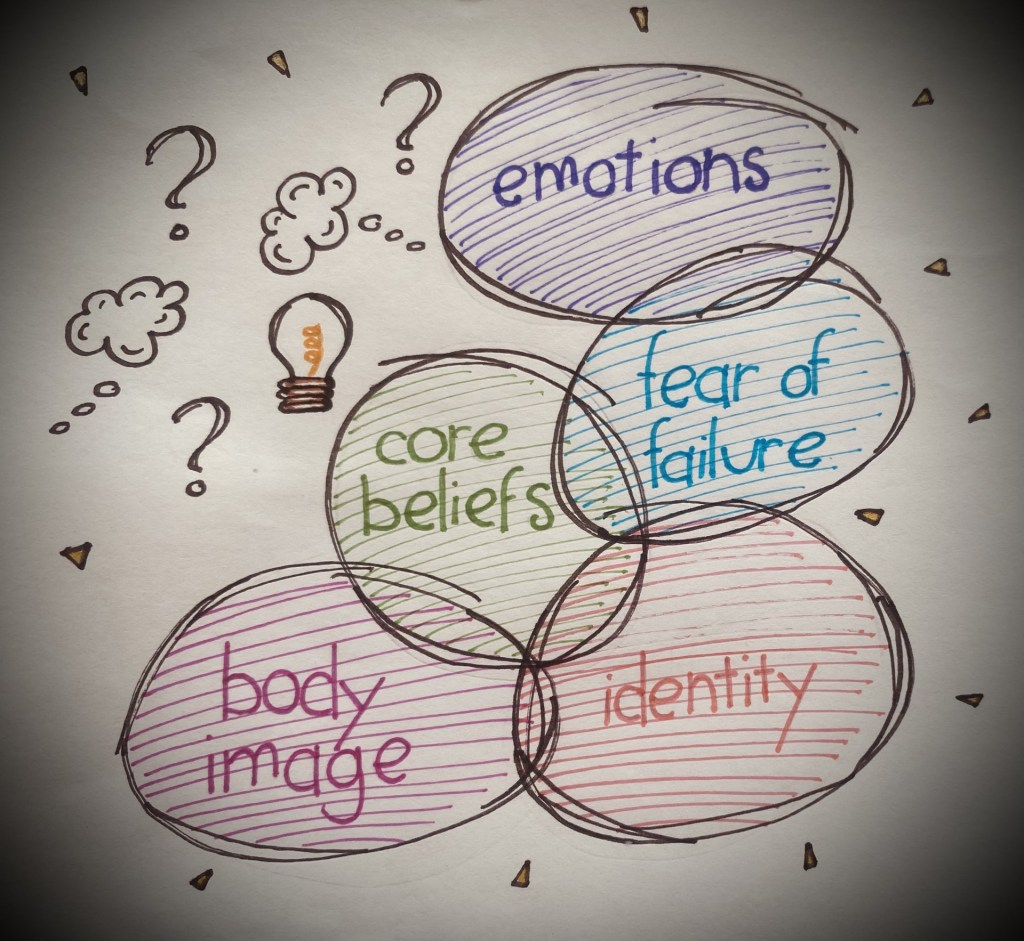
So my core beliefs include that I am unsafe and I am not good enough. Core beliefs develop in early life and are strengthened through experiences. My negative experiences of friendships, the impact of my dad’s illness on home life, my indecisiveness around study and career choices, my development of a negative body image; all served in the development and maintenance of these core beliefs. My emotional reaction to these core beliefs has been fear of rejection and fear of failure. My management of this fear has been hindered by my poorly developed ability to identify and respond to emotions in a helpful way. Further hampered by the numbness I have experienced in my response to the frequent activation of my sympathetic nervous system. A general lack of guidance throughout childhood and adolescence resulted in the development of emotional reasoning and role confusion, the latter aided by those poor peer connections. The assumption that has developed from my core beliefs is that I must achieve. Restricting food, exercising to excess, and the resulting weight loss, has facilitated a sense of achievement. This was learned after attention was drawn to weight gain in my teens. It also provided a solution to role confusion, providing me with a ‘skinny’ identity as well as countering negative body image, which itself also resulted from being made conscious of my weight and the focus on ‘big stomachs’ within my family environment. Just for good measure let’s throw in that perfectionistic personality, likely both inherited and modelled. Relentlessly striving for extremely high standards has fed into core beliefs and body image and has driven control behaviours that have made me feel safe.
Wow, that’s a lot of reflection, exploring and formulation right there. And to think I have been searching for a single cause behind the effect. No wonder I couldn’t find it. I said it was complex and I may have put some pieces of the jigsaw in not quite the right place, but the image is now a lot clearer. And now I can see the full picture, I also understand the solution(s). I’ll come to these in another blog…
There are also additional considerations around why the significant deterioration in recent years, but that too can wait for another blog…
 discoveringchocolatedigestives.blog
Leave a comment